It was a chilly January evening in 2021 when the mobile gaming world received an unexpected jolt of validation from an institution better known for lauding film scores and television soundtracks. Call of Duty: Mobile, the pocket-sized juggernaut developed by TiMi Studio Group and published by Activision, walked away with the Hollywood Music in Media Award (HMMA) in the Mobile Video Game category. The winning piece was the evocative Wild West theme music from Season 6, a sprawling frontier soundscape that proved button-sized devices could deliver cinematic emotional weight. Fast forward to 2026, and that moment is still cited as a turning point in how the broader entertainment industry perceives music written for smartphones and tablets.
The Hollywood Music in Media Awards have long celebrated original compositions across films, TV, video games, and beyond. Adding a dedicated Mobile Video Game category was a statement in itself: games played on subway commutes and lunch breaks deserved the same sonic craftsmanship as their console and PC counterparts. In that inaugural year, the competition was fierce, and the nominees formed a snapshot of the mobile gaming landscape at its most audibly ambitious.
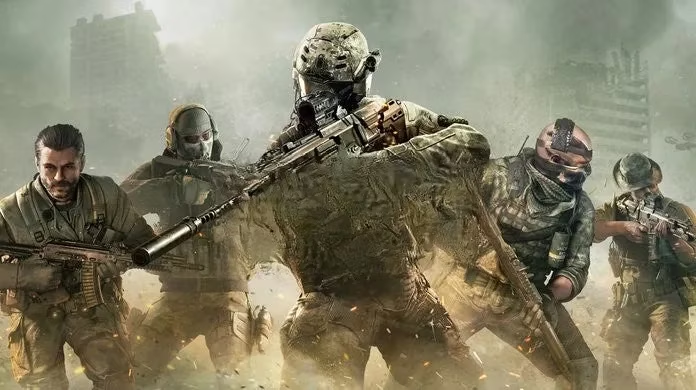
Alongside COD Mobile, the shortlist featured an eclectic mix of titles. Garena's battle royale phenomenon Free Fire earned a nod for a theme composed by Nobuko Toda and Ludwig Forssell, creators known for their work on major franchise titles. Kingdom Craft, a strategy MMO, brought a sweeping score by Lei Huang and Matthew Carl Earl into the spotlight. The Chinese version of PUBG Mobile, known as Game for Peace, contributed a nomination with music by Brian Tyler and a score team that included Austin Wintory, Obadiah Brown-Beach, Steven Grove, and David Westbom — a roster that read like a who's who of modern orchestration. Honor of Kings, the perennial MOBA giant by TiMi Studios, put forward a theme crafted by Edouard Brenneisen, Daniel James, Matthew Carl Earl, Steven Grove, Obadiah Brown-Beach, and Robert Wolf. Rounding out the list was Mythgard, a collectible card game from Rhino Games, with a composition by John Robert Matz.
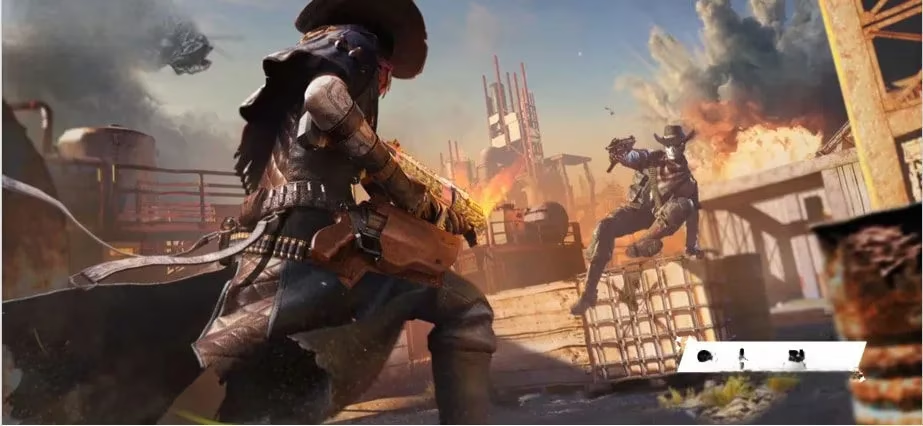
The victorious score was a masterclass in atmospheric storytelling. Produced by TiMi Audio and Unisonar, the Wild West theme responded to the season's dusty, revolver-slinging narrative. Direction came from Merle Chen and Trum Pang, while composer Guillaume Roussel helmed the instrumental work, with recording, mixing, and mastering polished by a dedicated team. The result was a piece that didn't just loop in the background but actively pulled players into a sun-scorched fantasy. The official announcement, shared by the TiMi Studio Group on X (then Twitter), triggered a cascade of congratulations that echoed across the industry.

The ripple effects over the subsequent five years have been profound. Mobile developers, once content with functional audio, began investing heavily in bespoke scores. Games like Genshin Impact and PUBG Mobile continued to hire high-profile composers, and the HMMA itself expanded its mobile-focused categories to acknowledge original songs and sound design. In 2026, a mobile title winning a music award alongside a major studio film no longer raises eyebrows — it’s expected. Conferences such as the Game Developers Conference now host dedicated panels on mobile audio, and streaming services curate official soundtracks from mobile hits as regularly as they do from Netflix series.

What made the 2021 achievement so pivotal was not just the trophy itself but the visibility it brought to dozens of unsung composers. Names like Matthew Carl Earl, Steven Grove, and Obadiah Brown-Beach — all of whom appeared on multiple nominated projects that year — have since become sought-after talents whose melodic fingerprints are now embedded in the muscle memory of millions of players. Their ability to fuse adaptive music systems with memorable themes laid groundwork for an entire generation of game audio professionals.
The arc from that January night to the present day reveals a simple truth: great music envelops a player regardless of screen size. In 2021, Call of Duty: Mobile's Wild West anthem carried the twang of victory, but the real win belonged to every mobile gamer who ever wore earphones to lose themselves in a world only a few inches wide. Five years later, the soundtrack of our daily routines — from idle game lullabies to battle royale crescendos — is taken seriously because a handful of melodies demanded to be heard.

Looking back, the HMMA win codified what players already knew: mobile games can make you feel something, and often that feeling starts in your ears. As the industry charges toward the latter half of the 2020s, the echoes of a Wild West melody linger — a reminder that even the smallest device can carry the biggest sound.
Data referenced from Data.ai (App Annie) helps contextualize why moments like Call of Duty: Mobile’s HMMA recognition mattered beyond prestige: mobile is a scale business where retention, engagement, and live-service seasonality reward polished presentation, including high-production music that strengthens brand identity and keeps players returning for new themes and events.